
Transfer die stamping separates the blank from the metal strip at the first station. It then uses mechanical or robotic transfer systems to move each part through subsequent forming stations independently. Basically, this makes it the preferred process for large, deep-drawn, and geometrically complex components that progressive dies simply cannot handle.
| Feature | Transfer Die Stamping | Progressive Die Stamping |
|---|---|---|
| Part Transfer Method | Mechanical fingers/robotic arms | Carried by the metal strip itself |
| Best for Part Size | Large, deep, or complex geometry | Small to medium, flat or shallow |
| Material Efficiency | High (parts are cut free early, less scrap) | Moderate (requires carrying web) |
Why Transfer Die Stamping Outperforms Progressive Dies for Complex Parts
Not every stamping challenge fits a progressive die. Basically, progressive dies work well for small, high-volume parts. The metal strip carries each blank through stations connected by a web. However, that web becomes a structural liability as part size increases or draw depth deepens. Consequently, transfer die stamping removes that constraint entirely — opening a capability that progressive tooling cannot match.
The distinction comes down to blank handling. In progressive stamping, the part stays attached to the carrier strip at every station. Therefore, the strip must remain intact, limiting how aggressively each station can form the material. The transfer die stamping separates the blank at station one. It moves as a free part from that point forward. As a result, each subsequent station applies full forming force from any angle — without the restrictions a connected carrier imposes.
Overcoming Progressive Die Limits with Transfer Die Stamping
Progressive dies reach their practical ceiling at moderate draw depths. Specifically, draw depths exceeding 50–60% of blank diameter cause the carrier web to lose structural integrity. It distorts or tears under the load. Furthermore, large blanks — floor pans, door inners, structural frame rails — generate forces that exceed what a progressive strip can absorb at the carrier bridges.
Transfer die stamping eliminates both constraints. Each station receives the blank as a discrete, unsupported part. Therefore, tooling engineers design each station around the forming requirement alone — not around strip limitations. Consequently, draw ratios that would tear a progressive strip become achievable. Blank sizes that progressive tooling cannot handle become standard production runs.
For heavy machinery engineers, this distinction is direct. It determines whether a part needs secondary operations, additional tooling investment, or a geometry redesign to fit process limitations.
Transfer Die Stamping Material Efficiency: Eliminating the Carrier Web
Progressive dies require a carrier web — the scrap skeleton that holds blanks together as the strip advances. In high-volume production, that web is consistent and unavoidable material loss. Specifically, web scrap represents 15–30% of total material consumption per part. The exact figure depends on blank size and nesting efficiency.
Transfer die stamping eliminates the web. The blank cuts to near-net shape at station one. It then transfers forward as a finished blank. Therefore, material utilisation improves directly and measurably. For Tier 1 suppliers running high-volume steel or aluminium programs, scrap reduction delivers a significant per-part cost advantage. Moreover, scrap handling, baling, and disposal costs decrease proportionally. Procurement managers should include that secondary saving in total cost of ownership calculations. For details on how SPSUNMOLD optimises blank utilisation across tooling programs, the manufacturing capabilities page covers the approach in full
High-Precision Handling in Transfer Die Stamping via Automated Robotic Systems
The robotic transfer system is a precision positioning device. It determines part location accuracy at every forming station. Specifically, modern servo-driven systems achieve positioning repeatability of ±0.05mm or better. That consistency holds across millions of production cycles.
This precision directly affects dimensional consistency in the finished part. Automotive structural components carry tight positional tolerances. Chassis nodes, B-pillar reinforcements, and longitudinal frame members all assemble directly to body-in-white structures. Consequently, transfer die stamping’s positioning consistency supports the GD&T requirements that Tier 1 and Tier 2 suppliers must meet under OEM sourcing agreements. Robotic end-of-arm tooling additionally provides six-axis flexibility. It handles deep-drawn shells and asymmetric structural brackets without distortion — a capability mechanical fingers cannot reliably deliver.
Automotive Chassis Components and Structural Frame Members
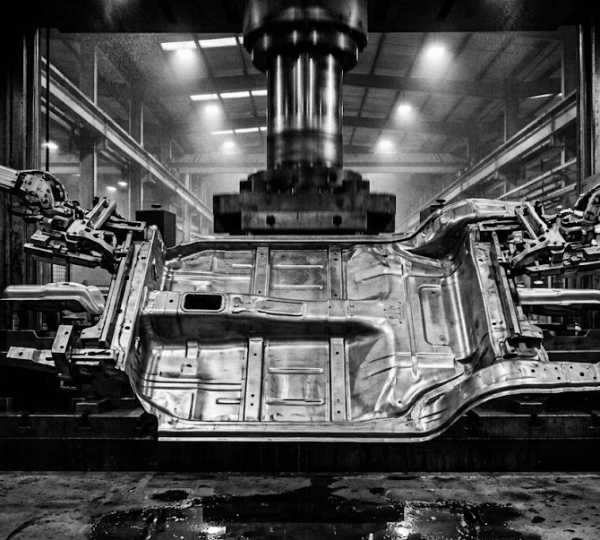
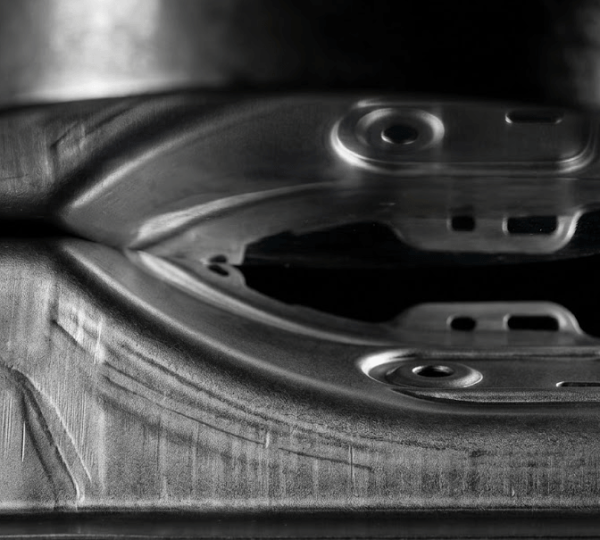
Chassis longitudinal rails, crossmembers, and floor pan assemblies are the core volume application for transfer die stamping. A full-length floor pan blank for a mid-size passenger vehicle exceeds 1,200mm in length. It requires draw depths of 80–120mm in multiple directions simultaneously. Progressive tooling handles neither requirement. Transfer die stamping, therefore, handles both as standard process parameters.
Chassis components also carry strict load path requirements. Material thinning during the draw process must stay within specification. Transfer tooling allows the die engineer to design draw beads, blank holder pressure profiles, and station sequences that control metal flow precisely. Wall thickness in critical load zones meets structural specification after forming. ASM International’s metal forming and stamping technical library documents the material behaviour and tooling design principles that govern multi-station draw sequence mechanics for structural automotive components.
Deep-Drawn Shells and Housings for Heavy Industry
Heavy machinery and commercial vehicle applications demand deep-drawn housings and structural shells. These parts exceed the draw capability of progressive tooling. Hydraulic cylinder end caps, differential housings, and transmission case components routinely require draw depths of 100–200mm. Tight wall thickness tolerances apply throughout the drawn section.
Transfer die stamping handles these requirements through controlled multi-station draw sequences. The blank progresses through a redraw station, an ironing station, and a trimming station. Each applies only the forming increment that the material can absorb at that stage. The finished part achieves the required draw depth without splits, wrinkles, or excessive thinning.
B-Pillar Reinforcements and Door Structural Inners
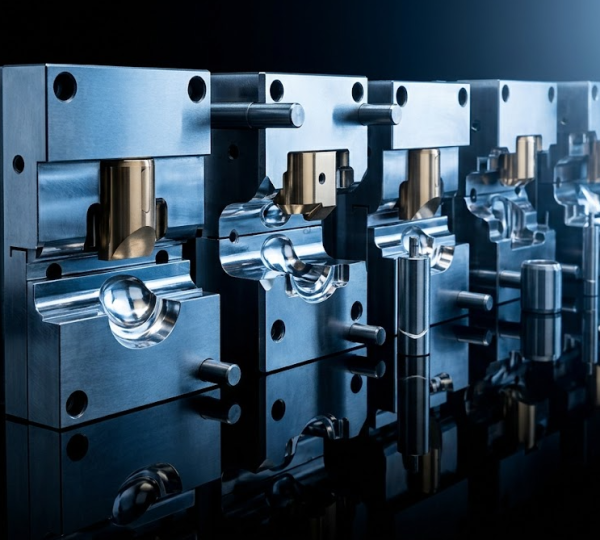
B-pillar reinforcements, door ring inners, and sill reinforcements combine large blank size with complex geometry and tight assembly tolerances. A B-pillar reinforcement for a full-size truck platform requires blanks exceeding 900mm in length. It also requires multiple compound curves and precise flange geometry for spot weld assembly to the body-in-white.
Robotic transfer arms handle the large, curved blank geometry without distortion between stations. Moreover, station-by-station forming distributes strain across multiple operations. It does not concentrate forming in a single draw that would exceed the material’s forming limit diagram. Transfer tooling, therefore, produces body structure components that meet OEM dimensional requirements consistently — across production volumes measured in hundreds of thousands of parts per year.
Setting the Standard for Complex Component Production
Transfer die stamping sets the standard for large, complex, high-volume metal components. It removes the constraints that limit every alternative process. Progressive tooling cannot handle the blank sizes, draw depths, or multi-directional forming that automotive structural components demand. Transfer die stamping handles all three. It simultaneously improves material utilisation, positioning precision, and station-to-station forming control. For Tier 1 and Tier 2 suppliers evaluating tooling architecture for next-generation structural components, transfer die stamping is the correct engineering answer for the application class it was built to serve.