
Concentricity failure in a high-speed shaft or bearing housing is not a minor defect. Basically, it causes vibration, premature bearing wear, and assembly interference that stops production lines. Therefore, procurement managers sourcing precision CNC turning services need a supplier who controls concentricity as a measurable, documented output — not a hoped-for result. Ultimately, the turning process, tooling strategy, and inspection system behind a machining partner determine whether cylindrical parts perform in service or fail under load.
Concentricity Is the Critical Dimension in CNC Turned Parts
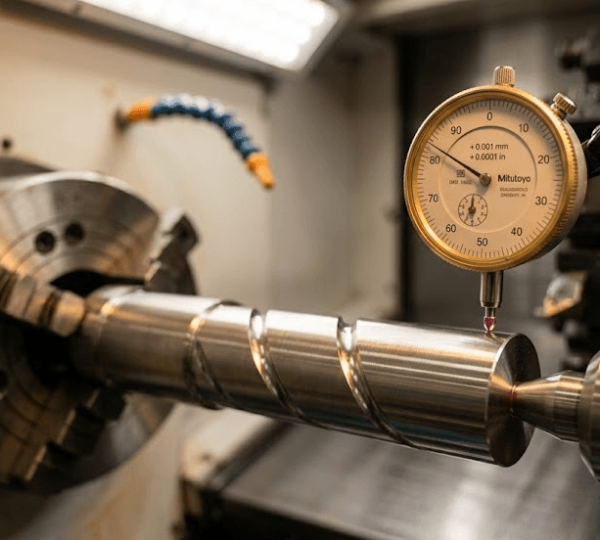
Most dimensional failures in cylindrical components trace back to concentricity deviation — not diameter error. Indeed, a shaft correct in diameter but off-centre by 0.01 mm causes measurable runout in a bearing assembly. Fatigue failure follows well before the designed service life.
The challenge compounds in high-volume production, where setup discipline directly determines batch-to-batch consistency. Re-chucking between setups introduces positional variation of 0.005–0.015 mm from grip misalignment alone. Consequently, single-setup turning — completing all critical diameters in one chuck — is the primary process control for concentricity.
Industries where concentricity tolerance drives specification:
- Aerospace — Bore and outer-diameter tolerances reach ±0.0025 mm, with concentricity under 0.005 mm for shafts and housings in fuel systems, actuation mechanisms, and turbine-adjacent assemblies
- Automotive and EV — Motor shafts, rotor shafts, and e-axle assemblies require concentricity under 0.005 mm to prevent vibration in high-RPM electric drive systems. In-process probing on EV rotor runs has demonstrated over 50% reduction in runout-related scrap
- Medical — Surgical instrument shafts and implant components require surface finishes to Ra 0.4 μm and concentricity tolerances measured in single-digit microns for reliable fit and biocompatibility
Furthermore, surface finish directly interacts with concentricity in sealing and bearing interfaces. A rough-turned bore that is dimensionally on-spec can still leak or fail to seat correctly. Accordingly, precision CNC turning must control both dimensions simultaneously — not as independent parameters. The same discipline applies when sourcing precision mould components; concentricity and surface finish interact at every interface that matters.
CNC Turning vs. CNC Milling: Choosing the Right Process for Your Part
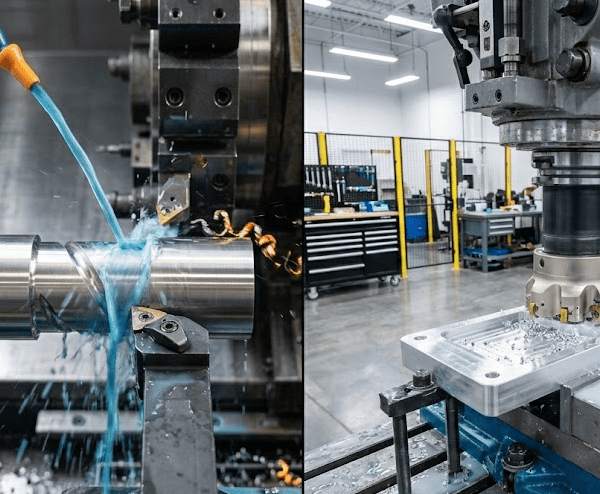
The distinction between turning and milling is fundamental. In CNC turning, the workpiece rotates, and the cutting tool is stationary relative to the axis of rotation. In CNC milling, the workpiece is fixed, and the cutting tool rotates.
This difference determines which process is appropriate for a given part geometry: CNC turning is the correct process for: Shafts, pins, bushings, sleeves, flanges, threaded fasteners, bearing housings, and any component where the primary geometry is rotationally symmetric about a central axis.CNC milling is the correct process for: Flat plates, brackets, pockets, slots, and complex non-symmetric geometries where features cannot be generated by rotating the workpiece
Moreover, turn-mill compound machining. According to the Society of Manufacturing Engineers, single-setup machining is consistently cited as the primary driver of concentricity improvement in high-volume cylindrical component production. where turning and milling operations occur in the same setup on a multi-axis machine — eliminates repositioning errors between operations. Notably, this suits cylindrical components that also carry milled features — keyways, cross-holes, or flat faces. Accordingly, turn-mill capability holds tighter composite tolerances on hybrid geometries than separate turning and milling on different machines.
Chaoyang’s Equipment and Quality Assurance
Chaoyang Hardware is ISO 9001:2015 certified and operates precision CNC turning across its Dongguan and Nantong facilities. Specifically, turning operations share the same quality system as Chaoyang’s grinding and EDM processes. This ensures traceable, consistent results across complex multi-process parts.
Materials processed by Chaoyang’s CNC turning operations:
- Tool steels — SKD11, SKH51, H13 (hardened to HRC 58–62 where specified)
- Pre-hardened steels — NAK80, P20, stainless steel grades
- Aluminium alloys — Including 6061 and 7075 for aerospace and EV structural components
- Brass and copper alloys — For electrical connectors, hydraulic fittings, and precision fasteners
- Engineering plastics — PEEK, Delrin, and PTFE for medical and low-weight applications
Process capabilities:
- Dimensional tolerances to ±0.002 mm on turned diameters
- Concentricity and runout control to within 0.004 mm on single-setup operations
- Surface roughness to Ra 0.4 μm on finish-turned faces and sealing diameters
- Thread turning to fine metric and unified thread standards
Quality assurance on every turned part:
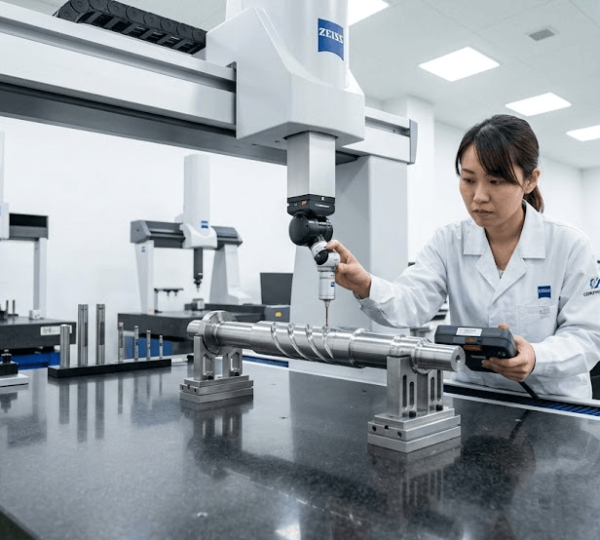
Every turned component ships after Zeiss CMM inspection. Dimensional verification runs against customer CAD data and is traceable to national measurement standards. Additionally, the Trimos height gauge, Nikon profile projector, and Rockwell hardness testing confirm dimensional and material compliance on hardened and heat-treated turned components. Clients, including Amphenol, Foxconn, BYD, and Yamaha, qualify Chaoyang’s turned components directly into production without incoming re-inspection. For a full overview of Chaoyang’s multi-process capabilities beyond turning, visit our precision CNC machining services page.
Precision CNC Turning Is a Process Discipline, Not a Machine Capability
Any CNC lathe can rotate a workpiece and remove material. Moreover, what separates precision CNC turning from commodity turning is process control. Single-setup strategy, in-process probing, and CMM verification produce concentricity as a repeatable output. Consequently, procurement managers who qualify on documented concentricity capability and ISO certification achieve lower scrap rates and fewer assembly failures. Indeed, keeping a shaft within 0.004 mm runout over 500 mm is a matter of process engineering, not machine specification. Ultimately, cylindrical components deserve a turning partner whose quality data can be reviewed.