
In high-volume production, stamping precision is never accidental—it’s the result of rigorous engineering decisions made before production even begins. The stamping process plays a decisive role in whether stamping die machining can achieve consistently high precision, stable output, and long-term cost-effectiveness. From digital design and simulation to material selection and high-precision manufacturing, every aspect of stamping die development directly impacts part quality and die life. Chaoyang is a manufacturer with extensive experience in precision machining and progressive die manufacturing, capable of implementing key design and manufacturing principles to achieve high-precision stamping performance, helping manufacturers reduce trial cycles, control errors, and achieve reliable, repeatable results in demanding production environments.
Targeted Stamping Die Machining Design and Simulation for Predictable Results
Good stamping begins with robust digital design. In stamping die machining, the earliest and most impactful interventions come from 3D CAD modeling and forming simulation. At Chaoyang, we rely on advanced CAD tools to translate part geometry and functional requirements into staged forming strategies. We then apply finite element analysis (FEA) and metal flow simulation to predict material thinning, wrinkling, and springback before any prototypes are produced. This virtual iteration reduces the need for actual trial-and-error and shortens the overall development cycle.
Specifically, we simulate strip layout and blanking to optimize material utilization and identify stress concentration areas that could lead to premature failure. Next, we model each progressive-die station to determine the appropriate spacing, die clearance, and blanking force for each station. In this way, we minimize parameter-guesswork and generate validated, data-driven strip-feeding schemes, thereby improving first-pass yield. By integrating CAD and forming simulation into the stamping die manufacturing process, teams can achieve predictable material flow, fewer stamping trials, and a shorter path from design to stable production.

Progressive Die Structure and Station Strategy in Stamping Die Machining
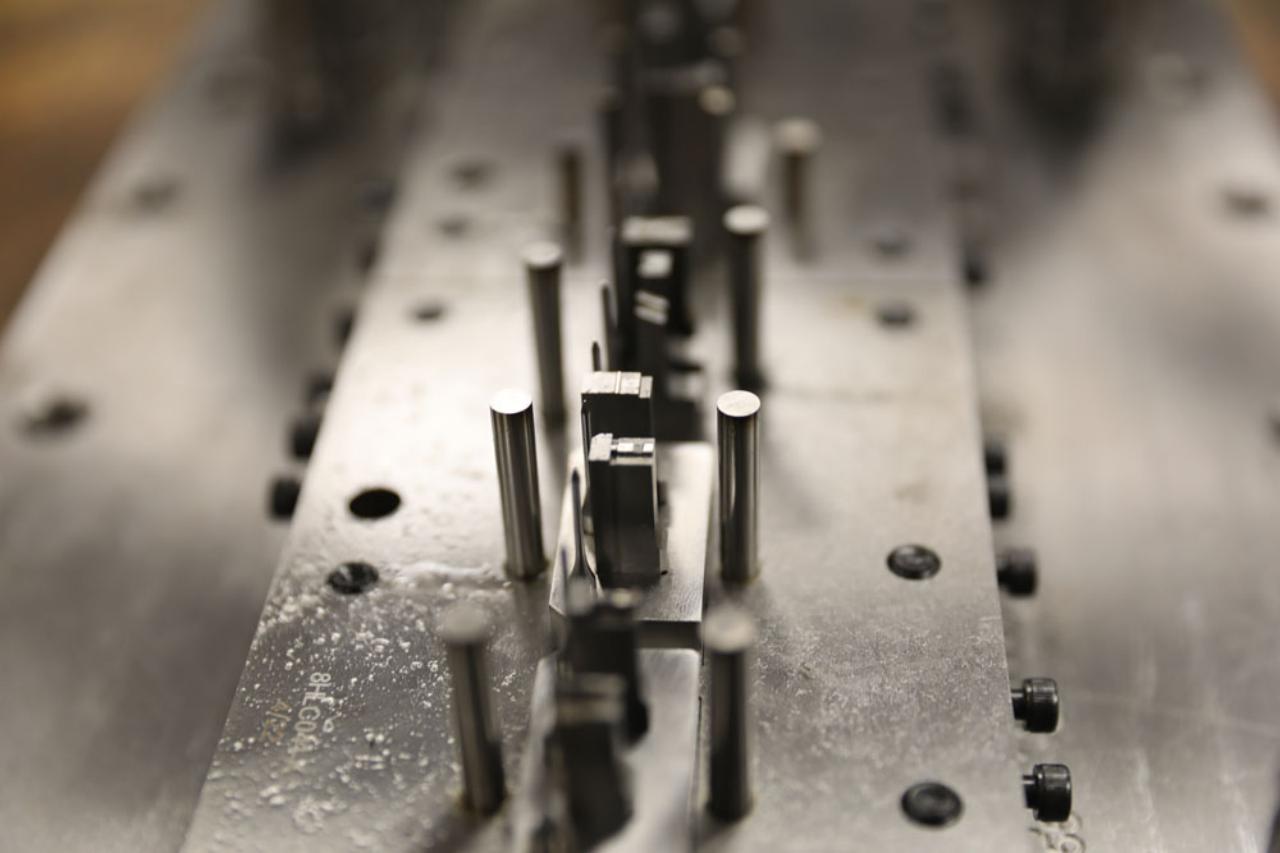
Progressive die design is one of the core technologies in stamping die machining. A well-designed progressive die can sequentially blank, punch, form, trim, and emboss metal strips, allowing each station to achieve predictable, limited deformation. We develop optimized strip layouts to minimize lateral movement and feeding errors of the strip material, and incorporate guide pins and locating features to ensure precise positioning of the strip under each punch.
Key principles include controlling metal flow at each station: using initial low-strain operations to distribute deformation and scheduling high-strain operations at subsequent stations where the metal is partially formed and constrained. For deep drawing or complex embossing, progressive stations can reduce springback through staged deformation. Sacrificial shearing or trimming stations can also be incorporated to remove burrs and prevent material buildup on subsequent dies. We also carefully consider stamping die spacing and feed length. Therefore, we use simulation validation to determine optimal spacing, balancing part geometry and stamping speed requirements.

Precision Manufacturing Processes and Advanced Equipment
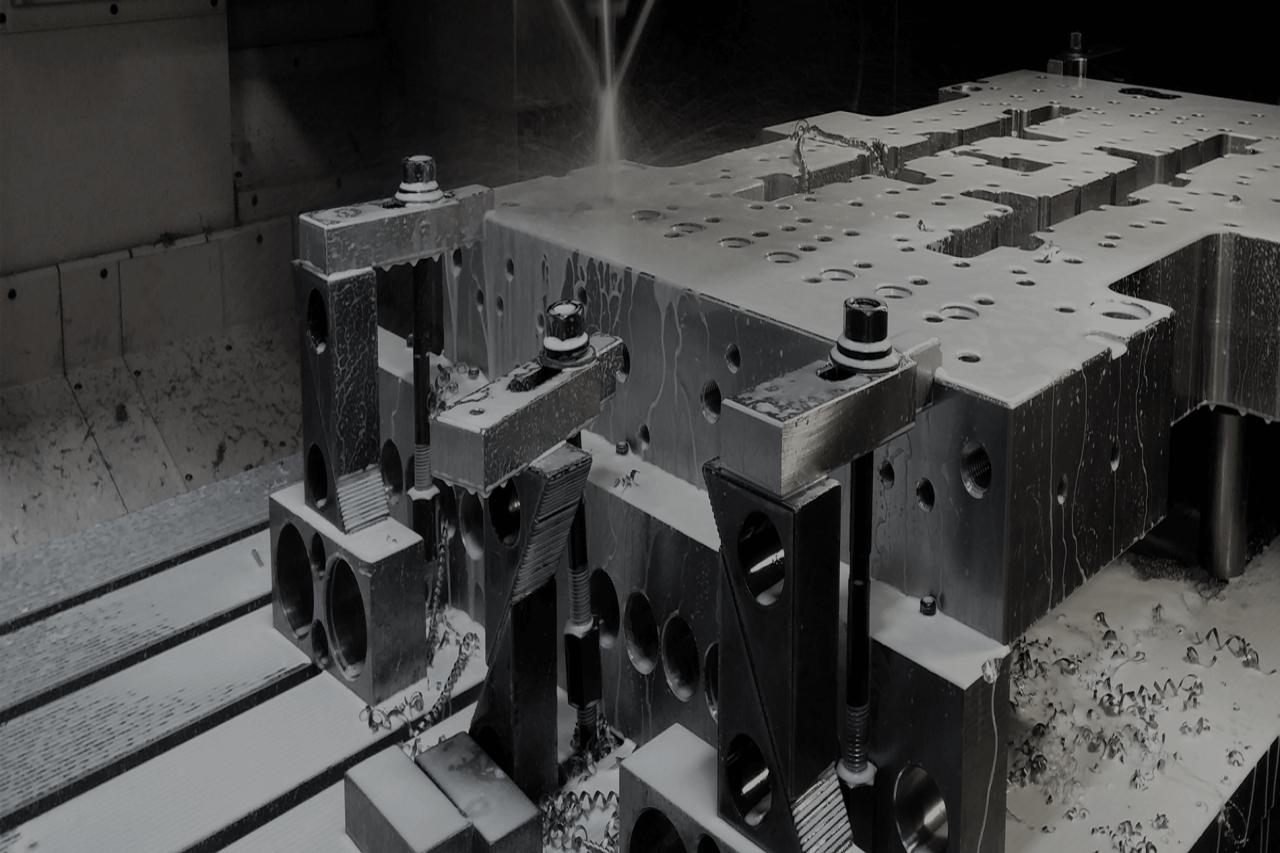
Precision design requires equally rigorous manufacturing processes. Stamping dies machining relies on precise milling, wire cutting, electrical discharge machining (EDM), precision grinding, and fine heat treatment. Chaoyang’s machining capabilities cover all aspects: CNC milling and turning for bulk material removal and fixture fabrication; Sodick oil-based wire EDM for fine contour machining; Moore JG and WASINO PG grinders for ultra-flat and concentric surface machining; and EDM for complex cavity shapes and sharp internal features.
We manage tolerances through process control. For example, wire EDM provides highly consistent kerf widths for stamping contours, while sinker EDM can engrave chamfer features and controlled radii. After EDM, we typically perform fine grinding or lapping to meet surface finish requirements and eliminate the recast layer. For micron-level tolerances, we use temperature-stable machining environments, short tool overhangs, and high-precision tool holders (shrink-fit or HSK) to minimize runout. Furthermore, we calibrate our machines daily and perform in-process probing to correct deviations actively. This equipment enables Chaoyang to machine complex progressive dies and achieve the surface integrity and geometric control precision required for high-precision stamping.

Assembly, Alignment, and Fixturing Strategies
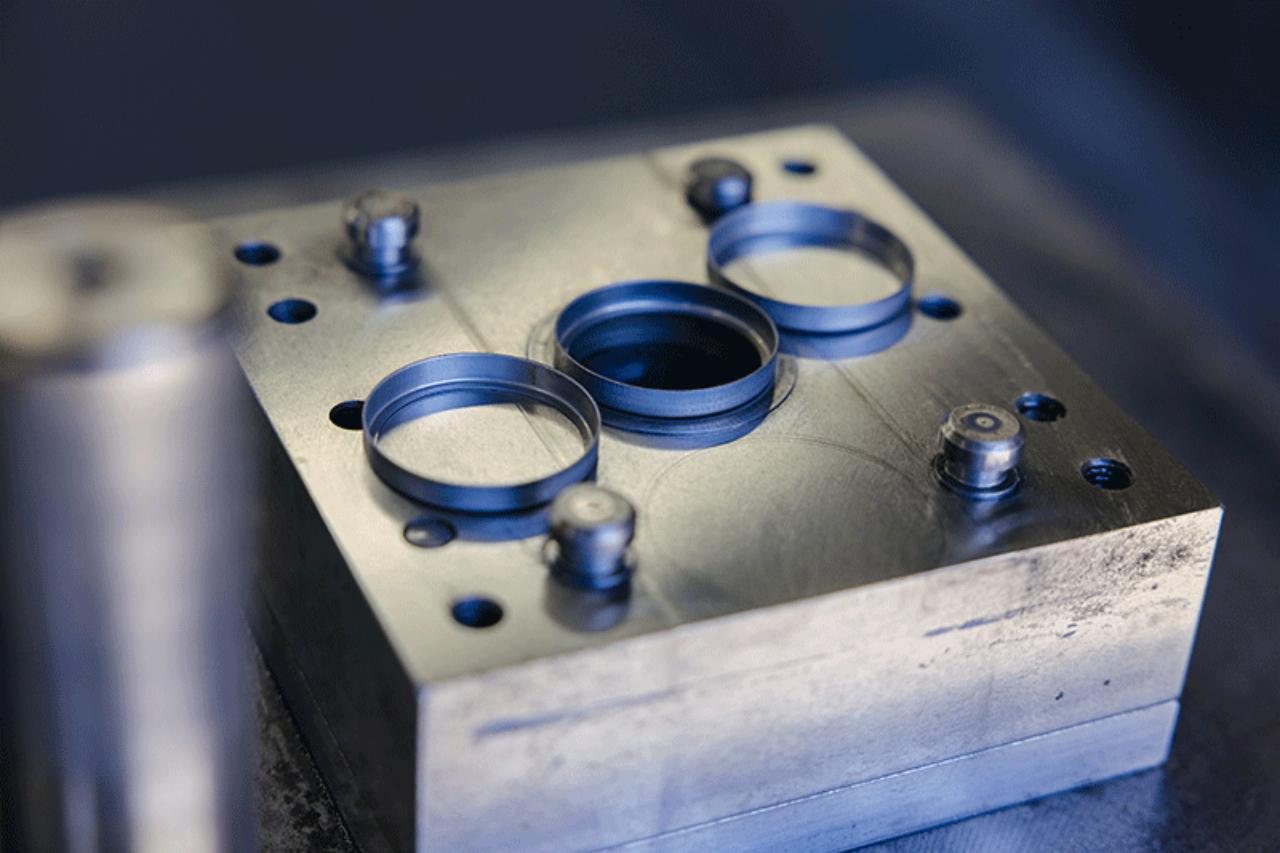
Assembly and fixturing combine machined parts into a stable, fully functional tool. In stamping die manufacturing, precise alignment is critical for the tool to operate within tolerances; otherwise, constant adjustments are required. We begin with robust die bases and motion-positioning systems to ensure repeatability in every assembly. Guide pins and bushings are held to tight tolerances, and preloaded linear guides or precision columns are used where appropriate to eliminate play.
We employ motion-coupling principles to ensure repeatability during reassembly after maintenance. For progressive dies, modular base plates allow for independent positioning of high-wear stations and controlled repositioning for replacement. Similarly, quick-change systems reduce downtime: technicians can replace inserts and re-establish datum points in minutes, rather than hours. We also use controlled torque specifications and distributed clamping to avoid elastic deformation that would otherwise shift critical clearances. For thin or asymmetrical parts, multi-point support and backer plates prevent bending under clamping loads.
Production Integration, Lifecycle Management, and Cost Optimization
Ultimately, stamping die machining must translate into a stable production schedule. Chaoyang’s approach links the performance to the stamping cell and the broader supply chain. We conduct trial runs to synchronize die dynamics with stamping speed, tonnage, and lubrication procedures. We then enter a defined ramp-up phase, incorporating operating speed, yield targets, and preventative maintenance tasks into the production plan.
Chaoyang design replaceable wear parts and stock spare parts for critical inserts. Preventive maintenance cycles are based on empirical wear models collected during the initial production phase; when components approach their wear limits, technicians replace the inserts and log the event. To control the total cost of ownership, we optimize die designs to improve material utilization, standardize die bases to reduce spare parts SKUs, and automate routine inspection tasks where feasible.
Building Reliable, High-Precision Stamping Performance
Chaoyang achieves this goal by integrating advanced 3D CAD simulation technology, optimizing mold design, selecting high-quality materials, and implementing strictly controlled manufacturing processes. Chaoyang combines robust and durable tool steel, cemented carbide, and ceramic materials with comprehensive machining capabilities (including CNC milling, electrical discharge machining, wire cutting, and precision grinding) to ensure that each stamping die has a long service life, dimensional stability, and repeatable performance. Therefore, with advanced equipment and complete production facilities, Chaoyang ‘s stamping die machining and design capabilities reduce production risks, shorten delivery times, and meet the high standards of the precision manufacturing industry.