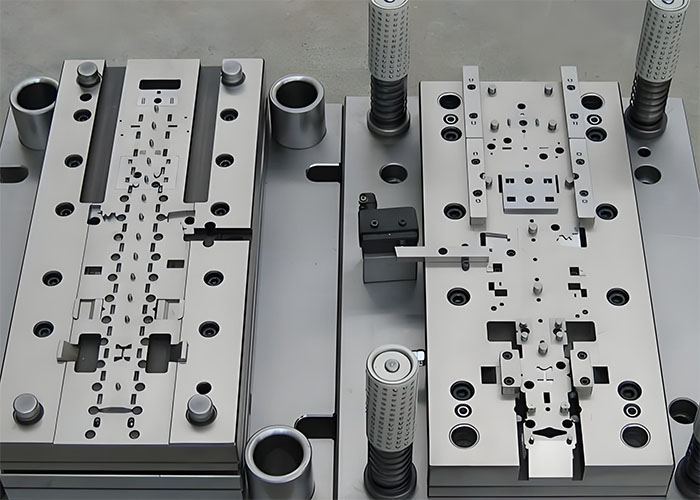
Stamping Die

Precision dies
Chaoyang blog

Stamping Die vs Injection Mold Key Differences for Metal Part Production

Metal part production often relies on two dominant forming technologies: stamping and injection molding. Both processes shape raw materials into functional components used in automotive, aerospace, electronics, and consumer products. Each method has strengths, limitations, and ideal application scenarios. Understanding the differences between stamping die processes and injection molding helps engineers, buyers, and production planners choose the right approach for their projects. Fundamental Process Differences At its core, stamping uses a press and a Stamping Dies to cut, bend, or form sheet metal. The material starts as a flat coil or blank. It moves into a die that applies mechanical force and produces the final geometry in one or multiple strokes. Injection molding, by contrast, begins with thermoplastic or metal powder fed into a heated barrel. Material melts or sinters, then is forced into a mold cavity. After cooling, the solid part ejects from the mold. Stamping primarily works with metals. Injection molding handles plastics and some metal injection molding (MIM) powders. These fundamental differences influence design, cost, and production dynamics. Design and Geometry Considerations Stamping tools excel at producing parts with uniform wall thickness and features like flanges, ribs, and cutouts. These shapes form through mechanical deformation rather than material flow. Stamping dies can also include progressive die stations for multi-step forming, reducing handling time. However, extremely deep or complex 3D shapes are more challenging to stamp and may require additional operations, such as secondary bending or trimming. In contrast, injection molding produces complex 3D geometries with undercuts, internal cavities, and intricate surface details. Designers often leverage draft angles and part consolidation to reduce assembly steps. While injection molds can handle complex shapes, they require careful design for wall thickness, cooling channels, and gate placement to avoid defects. Material Behavior and Selection Stamping processes typically use ductile metals such as steel, aluminum, copper, and brass. These materials deform under pressure without cracking. The selection depends on yield strength, elongation, and surface finish requirements. The stiffness and work-hardening behavior of metals directly influence die design and press tonnage. Injection molding uses polymers such as ABS, nylon, and polycarbonate. In metal injection molding (MIM), fine metal powders are mixed with polymers and later sintered to the final density. This method allows the use of stainless steel, tool steel, or other alloys in small and complex parts. Yet, MIM adds cost and complexity compared to standard plastic molding. Tooling Cost and Lead Time The tooling cost is a significant difference between these two methods. Stamping dies often require substantial upfront investment, especially for progressive die systems with multiple stations. A high-quality stamping tool can cost tens of thousands to hundreds of thousands of dollars, depending on complexity. However, the unit cost drops dramatically once production begins. Lead time for a stamping die ranges from a few weeks to months, depending on design and validation cycles. Injection molds also demand upfront investment. Mold cavities, cores, and cooling systems must match material and geometry precisely. For simple plastic parts, mold costs may be comparable to those for stamping dies. For complex metal injection molds or multi-cavity plastic molds, the cost escalates further. Lead times for molds typically fall within a similar range but depend on the number of cavities and the complexity of the cooling channels. Production Speed and Cost Per Part After tooling is complete, stamping delivers exceptionally high production rates. Modern stamping lines can cycle hundreds to thousands of strokes per minute. High-volume automotive panels, chassis components, and precision connectors rely on these high speeds to meet demand. The cost per part decreases rapidly as volumes grow, making stamping ideal for large runs. Injection molding also achieves high throughput, especially in plastics. Multi-cavity molds and automated handling systems further boost cycle efficiency. MIM production cycles tend to be slower due to the cooling and sintering stages. Still, injection molding remains cost-effective for moderate to high volumes of complex shapes, particularly in consumer electronics and appliance markets. Quality and Tolerance Control Both processes can achieve tight tolerances, but the methods differ. Stamping controls tolerances through die design, press capacity, and material handling systems. Accurate Stamping Die machining, die alignment, and consistent feed control play a significant role. For flatness, hole location, and concentric features, stamping can meet strict requirements when properly designed and maintained. Injection molding achieves dimensional control through mold precision, thermal management, and material behavior. Variations in cooling can cause shrinkage or warping, so mold design must account for these factors. Plastic parts often include design features that offset expected shrink rates. In MIM, sintering shrinkage requires consistent part placement and uniform density to maintain tolerances. Application Scenarios and Industry Use Stamping excels at producing sheet-metal parts. Automotive body panels, brackets, chassis components, and electrical shields are typical examples. Progressive dies support multiple forming steps on a single press line, reducing part handling and improving consistency. When flat stock needs bending, trimming, and piercing in one sequence, stamping shines. Injection molding dominates the production of plastic components, housings, clips, and ergonomic parts. In medical and consumer products, injection molding delivers complex 3D shapes with aesthetic appeal. Metal injection molding extends these capabilities to small, intricate metallic components where traditional machining would be inefficient or impossible. Choosing Stamping Die for Metal Part Projects Choosing between a Stamping Die process and injection molding depends on part design, material choice, volume, and cost targets. Stamping offers high-speed production and low unit cost for metal parts once tooling is complete. Injection molding supports detailed 3D geometry and complex features often required in plastics and MIM. Understanding these core differences helps engineers select optimal manufacturing strategies. By aligning design intent with process capability, companies achieve better quality, faster delivery, and lower total cost over the product lifecycle.
tamping die manufacturer
Chaoyang blog

Choosing the Right Stamping Die Manufacturer for High Precision Projects

High-precision projects require reliable tooling. Poor-quality tooling leads to scrap, downtime, and cost overruns. Conversely, experienced suppliers deliver consistent parts. Therefore, choosing the proper stamping die manufacturer is crucial. Here’s how to evaluate their capabilities, quality systems, and experience. We offer practical tips for selecting a partner that meets your precision requirements. Read on for practical guidance to ensure your stamping project is a success. Assess Technical Capabilities Start by reviewing the manufacturer’s equipment and technology. Do they use CNC machining, EDM, and precision grinding? Can they handle complex geometries and tight tolerances? Also, evaluate their simulation and prototyping capabilities. Consequently, you can gauge whether they can meet your project’s technical demands. Moreover, check their experience with the materials you plan to use. This helps avoid issues with wear, springback, or finishing. Ultimately, a well-equipped stamping die manufacturer can deliver accurate, repeatable results on time. Evaluate Experience with Similar Projects Past performance indicates future success. Ask for case studies or references from projects with similar precision or complexity. Additionally, verify their track record in industries such as automotive, electronics, or aerospace. Consequently, you can assess whether their expertise matches your project’s needs. Furthermore, check their problem-solving approach and responsiveness. Experienced teams anticipate challenges and proactively offer solutions. Therefore, you reduce the risk of delays and rework. Selecting a stamping die manufacturer with relevant experience ensures smoother project execution. Quality Management and Certifications Quality systems matter in precision stamping. Ensure the manufacturer follows ISO or industry-specific standards. Moreover, verify inspection capabilities, including CMMs and other metrology tools. Consequently, parts meet tolerance consistently. Also, ask about process documentation and traceability. This guarantees accountability for materials and processes. Furthermore, robust quality management reduces scrap and defects. Overall, a stamping die manufacturer with certified quality systems provides confidence in consistent output. Material Knowledge and Compatibility Not all manufacturers handle every material effectively. Verify their experience with steels, aluminum, copper, or specialty alloys. Additionally, consider the surface treatments and coatings that can be applied. Consequently, you avoid die wear, part deformation, or finishing problems. Moreover, proper material handling has a significant impact on tolerance and lifespan. Ensure the stamping die manufacturer understands metallurgy and the interactions with tooling. This knowledge supports high-precision outcomes and prolongs life. Delivery and Production Capacity Timely delivery matters in high-precision projects. Evaluate their production scheduling, capacity, and lead times. Also, consider flexibility for prototyping or urgent orders. Consequently, you avoid project delays and inventory issues. Furthermore, check how they handle scaling from small batches to full production. Efficient logistics and planning enable a stamping die manufacturer to meet both short-term and long-term demands. Cost Considerations Without Compromise Price is important, but quality and precision take priority. Beware of manufacturers offering unusually low bids. They may cut corners or use outdated processes. Conversely, reasonable investment in capable partners reduces defects and rework. Also, consider lifecycle costs, including maintenance, adjustments, and replacements. Consequently, choosing a stamping die manufacturer based on total value ensures project success and cost-efficiency. Communication and Support Clear communication reduces misunderstandings and errors. Assess responsiveness during inquiries and design discussions. Additionally, ensure they provide technical guidance and updates throughout the production process. Consequently, you stay informed and avoid surprises. Furthermore, a collaborative approach improves problem-solving. Selecting a stamping die manufacturer with strong communication practices strengthens project reliability and customer satisfaction. Final Recommendations for Stamping Die Manufacturer To select the proper stamping die manufacturer, begin by conducting a technical evaluation, reviewing their experience, and verifying their quality. Then, confirm material compatibility, production capacity, and delivery reliability. Also, consider total lifecycle costs and ensure clear communication throughout the process. Finally, seek references and validate past projects to confirm capabilities. By following these steps, you can ensure high-precision parts, reduce risk, and achieve smooth project execution with trusted Stamping Die Manufacturers. Chaoyang is an experienced stamping die manufacturer that integrates design and manufacturing. If you have mold customization needs, please don’t hesitate to contact us.

Stamping Die
Chaoyang blog

What Makes a Good Stamping Die for Type-C Connector Parts?

Type-C connectors are one of the most widely used interfaces in today’s electronic products. The compact size and versatility make it popular among manufacturers across various industries. However, it has a delicate internal structure, numerous pins, a dense layout, and challenging welding. Additionally, the stamping die tolerances in the manufacturing process are extremely strict. If the stamping dies accuracy does not reach microns, misalignment, part failure, and a significant amount of time and money will be wasted. Precision requirements for Type-C geometry Type-C connectors are compact, typically with wall thicknesses under 0.2 mm. Therefore, the stamping die must consistently maintain tolerances in the micron range. Standard deviation in dimensions can lead to functional failures, including poor mating, misalignment, and unstable data transmission. To achieve this, the die must be designed using high-precision machining and advanced CAD/CAM systems. Every cavity, edge, and profile must be optimized for minimal wear and repeatability. The correct gap between punch and die is crucial—too tight, and you risk rapid wear; too loose, and you compromise accuracy. Material selection for die longevity Not all die steels are created equal, especially when dealing with stainless steel or copper alloy sheets commonly used in USB-C components. Tool steels, such as DC53 or ASP23, provide the hardness and toughness necessary to withstand millions of cycles. Additionally, coatings such as TiCN or DLC can significantly reduce friction and wear, thereby extending the lifespan of the die. Choosing the right material and coating combination means fewer shutdowns and lower long-term costs. A reliable stamping die starts with intelligent material selection. Die design for burr-free edges Burrs are the enemy of electrical contacts. For Type-C parts, even the smallest burr can interfere with signal integrity or assembly. That’s why the die must be engineered to minimize burr formation during blanking and forming. This involves optimizing the shear angle, punch sharpness, and clearance between mating surfaces. Multi-stage progressive dies can also be designed to include a deburring or coining stage, ensuring parts exit the press with a clean finish. Tight strip layout and material utilization The layout of the strip—the metal sheet as it passes through the die—is a key element in both cost and quality. For small components, such as Type-C contacts, even a 0.1 mm misalignment can cause reject rates to spike. High-quality stamping dies utilize precise pilot pins, guides, and sensors to ensure alignment. Moreover, optimizing the layout for material usage can reduce scrap, especially when working with expensive materials like beryllium copper. Less waste means higher profitability. Durability in high-volume production USB-C connectors are produced in massive quantities, so the die must withstand high-speed, high-cycle operation. This places stress on every part of the die, including guides, punches, springs, and strippers. Advanced die builders use hardened components and precision-ground surfaces to ensure long-term durability. Regular maintenance cycles can be built into the die’s design to minimize downtime. A stamping die built for endurance supports uninterrupted production lines. Integration with automation systems In modern facilities, diseases rarely operate in isolation. Instead, they form part of fully automated stamping lines. For USB-C components, automation ensures consistency and reduces labor costs. A high-quality stamping die includes provisions for sensors, ejectors, and automatic feeding systems. These elements ensure smooth part ejection, real-time quality checks, and alignment correction. Integrated automation reduces errors and boosts efficiency. Quality control and stamping dies validation Building the die is only half the equation—validating its performance is equally important. Manufacturers must perform pre-article inspections, capability studies, and pilot runs to ensure that the stamping die meets performance criteria. Inspection methods, such as vision systems or laser measurement tools, help catch defects before full-scale production begins. Documentation and revision control also play a role. A validated stamping die provides confidence and data-backed assurance. Choosing the proper stamping die facilitates the manufacturing of USB-C parts In USB-C production, it is crucial to see the precision stamping die. It determines whether the output is smooth because even a slight deviation may cause part scrapping and waste of resources. Choosing the right material and design, combined with strict quality control, can help maintain stable production and minimize waste.

Scroll to Top